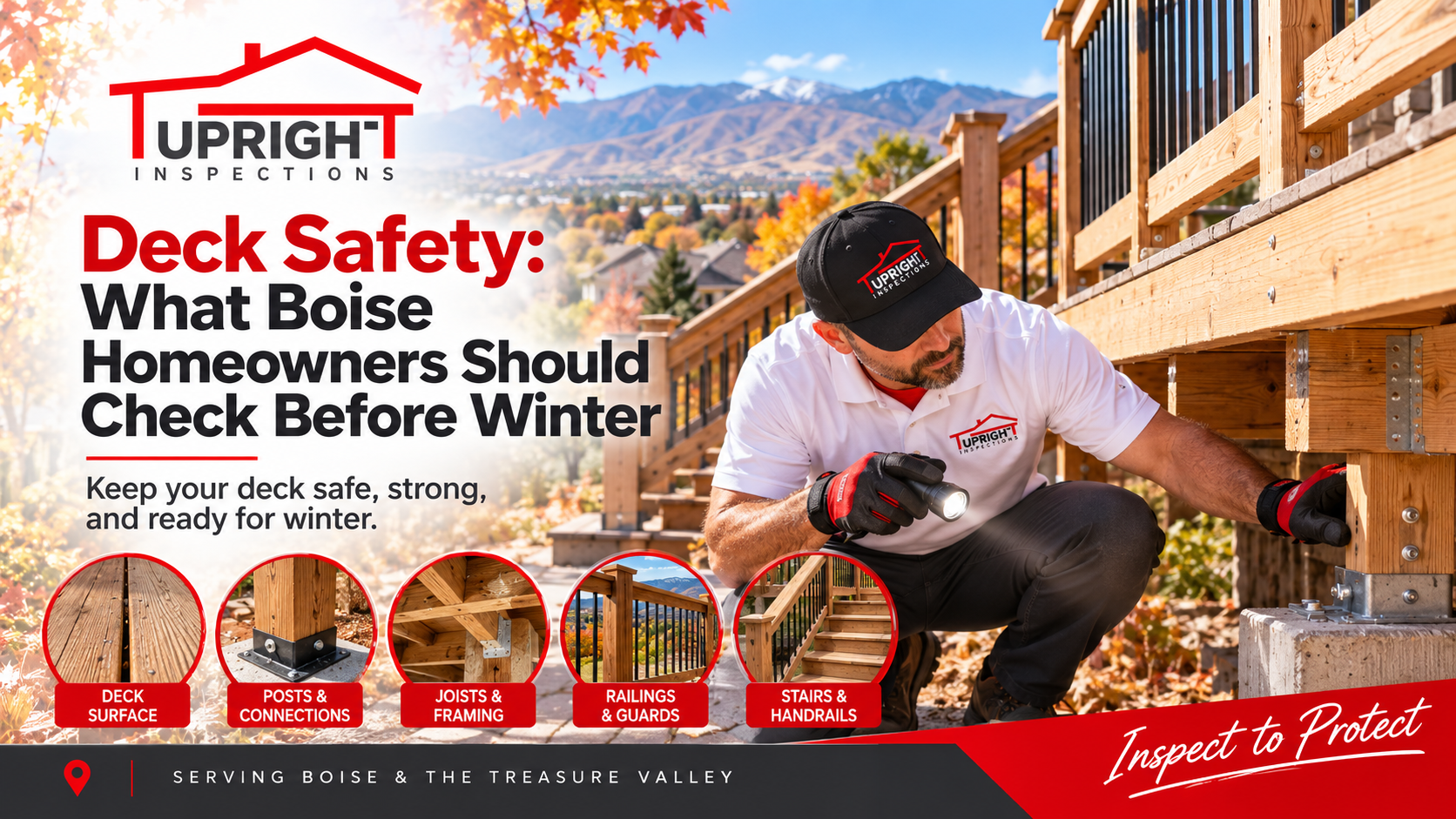
Fall Deck Safety in Boise: 8 Things Homeowners Should Check Before Winter
A Boise-area deck gets exposed to sun, snow, rain, irrigation, temperature swings, and years of freeze-thaw cycles. By the time fall arrives, small problems that developed during the summer can become more apparent—and winter weather can make existing defects worse.
Before the first snow, take a few minutes to look closely at your deck, stairs, and railings. For homeowners, buyers, sellers, and real estate agents, fall is an excellent time to identify visible conditions that may affect safety, maintenance, or durability.
1. Look at the Deck’s Connection to the House
The area where a deck attaches to the house deserves special attention.
Look for:
Loose or deteriorated connections
Visible corrosion
Damaged framing
Separation between the deck and house
Evidence of water intrusion
Deteriorated ledger-area materials
Missing or questionable flashing
The deck-to-house connection is an important structural area because the connection transfers loads from the deck into the building.
If something appears loose, damaged, or improperly supported, don’t assume adding a few screws will solve the problem. A qualified contractor or structural professional may need to evaluate the connection.
2. Check Posts, Beams, and Framing
Walk around the deck and look at accessible structural components.
Pay attention to:
Cracked or split wood
Rot or decay
Significant insect damage
Sagging or uneven framing
Loose connections
Corrosion at metal hardware
Wood in contact with soil
Areas that remain chronically wet
Not every crack is a structural failure, and not every weathered board requires replacement.
The important question is whether deterioration appears to affect the structural component or its connection.
InterNACHI’s Standards of Practice include inspection of attached decks, balconies, porches, steps, and related railings, guards, and handrails when they are within the inspection scope and readily accessible.
3. Don’t Ignore the Railings and Guards
Railings and guards are there for a reason: fall protection.
Look for:
Loose posts
Loose handrails
Damaged components
Excessive movement
Missing sections
Deteriorated wood
Openings that appear unusually large
A railing can look solid while having a loose connection at its base.
If you can move a railing noticeably by hand, it deserves closer attention.
4. Check the Stairs
Deck stairs should also receive a close visual inspection.
Look for:
Loose or damaged stair components
Deteriorated stringers
Loose handrails
Damaged treads
Uneven or deteriorated walking surfaces
Poor attachment
Excessive movement
Areas where water collects
Stairs can become especially hazardous during winter when moisture, ice, and snow are added to an already deteriorated walking surface.
5. Watch for Wood Rot
Boise’s relatively dry climate doesn’t mean exterior wood is immune to moisture damage.
Irrigation systems, snow, rain, poor drainage, leaking gutters, and landscaping can keep portions of a deck wet for extended periods.
Pay particular attention to:
Post bases
Stair stringers
Ledger areas
Beam ends
Areas beneath planters
Wood near landscaping
Places where water consistently collects
A screwdriver or probe isn’t a substitute for a professional evaluation, and inspectors should avoid damaging materials simply to determine whether concealed deterioration exists.
If significant deterioration is suspected, further evaluation may be appropriate.
6. Look at the Surface—But Don’t Stop There
Deck boards are what homeowners see most often, but the surface isn’t the whole deck.
Look for:
Splitting boards
Loose fasteners
Raised nails or screws
Excessive weathering
Slippery organic growth
Soft or deteriorated areas
Trip hazards
Then look underneath.
The structure supporting the deck is often more important than the appearance of the walking surface.
7. Check Where Water Goes
Fall maintenance is also a good time to look at drainage around the deck.
Ask:
Where does rainwater go?
Look for water collecting near:
Deck posts
Foundation walls
Stair landings
Retaining walls
Low areas beneath the deck
Also check whether gutters and downspouts are directing roof runoff onto or beneath the deck.
Water management problems can accelerate deterioration of exterior wood and contribute to moisture concerns around the home.
8. Clear Leaves and Debris
Leaves may look harmless, but piles of organic debris can hold moisture against wood surfaces.
Before winter:
Sweep the deck.
Clean between deck boards where accessible.
Remove leaves beneath the deck.
Clear debris from stairs.
Keep drainage areas open.
Trim vegetation that prevents the deck from drying.
Check that snow and water have reasonable pathways away from the structure.
A clean deck is easier to inspect and easier to maintain.
Buyers: Don’t Let a Nice Deck Hide a Structural Concern
A freshly stained deck can look fantastic during a showing.
But appearance doesn’t tell you everything about the structure.
If you’re purchasing a Boise, Meridian, Eagle, Nampa, or Star home with a deck, pay attention to the:
House connection
Posts and beams
Stairs
Railings and guards
Walking surfaces
Hardware
Drainage
Visible deterioration
A home inspection can help identify readily observable conditions that may warrant attention.
InterNACHI’s Standards of Practice describe a home inspection as a non-invasive visual examination of accessible areas and specifically note that an inspection is not technically exhaustive and will not identify concealed or latent defects.
That distinction matters with decks because important structural components can sometimes be concealed behind finishes or inaccessible from normal inspection positions.
Sellers: Get Ahead of the Inspection
If you’re preparing your home for sale, fall is a good time to address obvious deck maintenance.
Consider:
✔ Tightening loose accessible hardware where appropriate
✔ Repairing damaged walking surfaces
✔ Removing leaves and debris
✔ Addressing obvious wood deterioration
✔ Repairing loose railings
✔ Clearing vegetation around the structure
✔ Improving obvious drainage problems
✔ Having significant structural concerns professionally evaluated
If a contractor performs repairs, keep the documentation.
A receipt or contractor report can give the buyer and their agent useful information about work that has already been completed.
What About Building Code?
This is where inspection reporting needs to be precise.
An inspection observation is not automatically a code violation.
Deck requirements can depend on factors such as:
When the deck was built
Whether it has been altered
The applicable code edition
Local jurisdiction
Structural design
The specific component being evaluated
An inspector may identify a loose railing, deteriorated structural member, or questionable connection without declaring that the condition violates a particular code provision.
When structural adequacy or code compliance needs to be determined, a qualified contractor, structural professional, or appropriate building authority should be consulted.
InterNACHI’s Standards of Practice also establish limitations on an inspector’s role, including not providing engineering services or determining the adequacy of structural systems.
Your Fall Deck Safety Checklist
Before winter arrives:
☐ Inspect the deck-to-house connection
☐ Look at posts, beams, and accessible framing
☐ Check for visible wood decay
☐ Check railings and handrails for excessive movement
☐ Look over stairs and stair components
☐ Check for loose or damaged deck boards
☐ Look for exposed or raised fasteners
☐ Clear leaves and organic debris
☐ Check drainage beneath and around the deck
☐ Have significant structural concerns professionally evaluated
A Deck Should Be Enjoyed—Not Just Maintained After Something Fails
A deck is an extension of your living space, but it is also a structure that has to withstand people, weather, moisture, and time.
Fall provides a good opportunity to inspect it while the weather is still manageable.
For buyers, a professional inspection can provide another set of eyes on the deck and its readily observable components. For homeowners and sellers, addressing visible maintenance concerns before winter can help protect the structure and reduce avoidable surprises.
Inspect to Protect
Whether you’re buying, selling, or maintaining a home in Boise, Meridian, Eagle, Nampa, Star, or throughout the Treasure Valley, Upright Inspections can help identify observable conditions that deserve attention.
Don’t just look at the deck surface. Look at what holds it up.
Schedule your home inspection with Upright Inspections.
Upright Inspections — Your Foundation for Peace of Mind