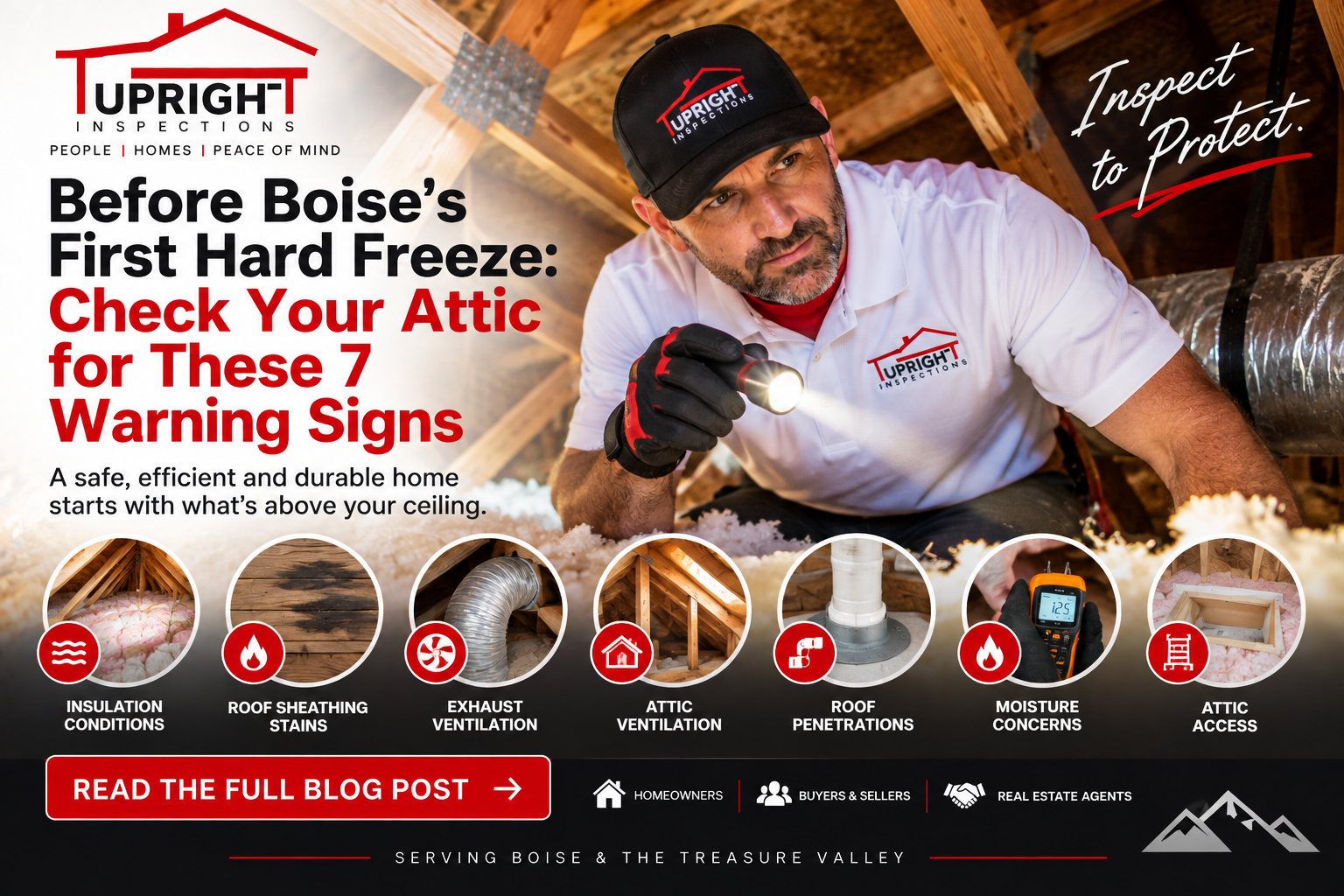
Before Boise’s First Hard Freeze: Check Your Attic for These 7 Fall Warning Signs
As October arrives in Boise and the Treasure Valley, homeowners naturally start thinking about furnaces, fireplaces, and winterizing the exterior. But one of the most important areas to prepare for cold weather is often out of sight: the attic.
Your attic plays a major role in managing heat, moisture, and ventilation. Problems involving insulation, air leakage, exhaust ducts, or roof ventilation can contribute to condensation, elevated energy use, ice-related roof problems, and moisture damage during the colder months.
Fall is an ideal time to identify readily observable concerns before winter conditions make them harder to address.
1. Check the Attic Access
Start with the attic hatch or access panel.
Look for:
Damaged or missing insulation around the access
Gaps that allow conditioned air to escape
Evidence of staining or moisture
Damaged weatherstripping or sealing
An access opening that is difficult or unsafe to use
An attic access doesn’t necessarily need to be airtight in every existing home to the same degree, but unwanted air leakage can contribute to heat loss and moisture movement into the attic.
If the access is part of the home’s thermal boundary, appropriate insulation and air sealing can be particularly important.
2. Look for Missing or Displaced Insulation
Insulation should generally be reasonably continuous across the attic floor where the attic separates conditioned living space from the unconditioned area.
Look for:
Bare areas
Significant gaps
Compressed insulation
Displaced insulation
Insulation blocking ventilation openings
Areas around penetrations where insulation is missing
InterNACHI’s Standards of Practice call for inspectors to inspect insulation in unfinished spaces and describe the type and approximate average depth observed, while noting that inspectors are not required to move or disturb insulation or determine its R-value.
That distinction is important: an inspector reports what is readily observable rather than dismantling the attic to determine every hidden insulation condition.
3. Watch for Roof Sheathing Stains
Look at the underside of the roof sheathing where accessible.
You may see:
Dark staining
Water marks
Rusted fasteners
Deteriorated wood
Moisture around roof penetrations
Areas of apparent condensation
A stain does not automatically mean there is an active roof leak.
It could represent an old leak, condensation, or another historical condition.
If the cause isn’t obvious, further evaluation may be appropriate.
InterNACHI’s Standards of Practice include the readily accessible roof structure and attic areas within the inspection scope, subject to accessibility and safety limitations.
4. Check Bathroom and Laundry Exhaust Ducts
This is one of the most important attic checks before winter.
Bathroom and laundry exhaust systems should generally discharge to the exterior rather than into the attic.
Look for:
Disconnected ducts
Ducts terminating inside the attic
Damaged or crushed flexible ductwork
Excessive sagging that can collect condensation
Missing insulation where appropriate
Improper termination locations
Warm, moisture-laden air discharged into a cold attic can contribute to condensation and moisture problems.
This is especially important during Boise’s colder months when the temperature difference between the living space and attic can become substantial.
5. Look for Blocked Soffit Ventilation
If your home uses soffit-to-ridge or other attic ventilation strategies, insulation should not unnecessarily block intended ventilation pathways.
Look for signs such as:
Insulation pushed tightly into soffit areas
Missing ventilation baffles where needed
Blocked soffit openings
Heavy debris around accessible ventilation openings
InterNACHI’s Standards of Practice include attic ventilation within the inspection scope, but specifically state that the inspector is not required to determine the adequacy of ventilation.
So an inspection observation such as “ventilation openings appear obstructed” is different from an engineering determination that “the attic has insufficient ventilation.”
6. Look for Signs of Excess Moisture
Fall is an excellent time to look for evidence of moisture before winter adds another seasonal load.
Watch for:
Condensation staining
Mold-like growth
Damp insulation
Rusted fasteners
Wet or deteriorated wood
Frost-related evidence from previous winters
Staining around bathroom exhaust locations
Moisture problems can have multiple causes.
A roof leak, plumbing leak, inadequate exhaust ventilation, air leakage, or condensation may all produce staining that initially looks similar.
If moisture or suspected microbial growth is observed, additional investigation may be appropriate rather than assuming the source.
7. Look at Attic Penetrations
The attic side of the roof can reveal conditions that aren’t obvious from outside.
Check accessible areas around:
Plumbing vent pipes
Chimneys
Skylights
Roof vents
Electrical penetrations
HVAC components
Exhaust ducts
Look for staining, gaps, displaced insulation, or other evidence of moisture intrusion or air leakage.
This is particularly useful when evaluating an older Boise home that has had multiple roof replacements, remodels, or mechanical upgrades.
Why Attic Problems Matter in Boise
Boise’s seasonal temperature swings make moisture control and insulation particularly important.
An attic that looks fine during a mild fall inspection can behave very differently during prolonged cold weather.
That’s why a good inspection isn’t simply about asking, “Is there insulation?”
It’s also about understanding the relationship between:
Heat + air movement + moisture + ventilation + insulation.
Problems in one area can affect another.
For example, excessive air leakage from the living space can carry moisture into the attic. If that moisture encounters cold surfaces, condensation can occur.
Home Buyers: Don’t Ignore the Attic
If you’re buying a home in Boise, Meridian, Eagle, Nampa, Star, or another Treasure Valley community, the attic can tell you a lot about the home’s history.
Look for evidence of:
Previous roof leaks
Inadequate or displaced insulation
Improper exhaust ventilation
Moisture intrusion
Remodeling work
Previous repairs
Structural alterations
A professional inspection can identify readily observable conditions that may not be obvious during a normal home showing.
But remember: InterNACHI’s Standards of Practice emphasize that a home inspection is a non-invasive visual examination of accessible areas, is not technically exhaustive, and does not identify concealed or latent defects.
Sellers: Make Your Attic Inspection-Friendly
If you’re preparing your home for sale, make sure the attic access isn’t blocked by stored belongings.
If accessible, consider checking for:
Obvious roof leaks
Disconnected exhaust ducts
Damaged insulation
Blocked ventilation
Water staining
Previous repairs
If you have already had roof, HVAC, insulation, or moisture work performed, keep the documentation.
That information can be valuable to your real estate agent and future buyer.
Real Estate Agents: An Attic Finding Doesn’t Always Mean a Major Repair
One of the most useful things an inspection report can do is distinguish between an observation and a conclusion.
For example:
Observation:
“Bathroom exhaust duct was observed terminating within the attic.”
Recommendation:
“Recommend evaluation and correction by a qualified contractor to properly exhaust moisture to the exterior.”
That’s different from automatically declaring that the condition has caused mold, structural damage, or a code violation.
The next step depends on the actual evidence.
Inspection Observation vs. Code Requirement
This distinction is especially important with insulation and ventilation.
InterNACHI’s Standards of Practice establish what an inspector should observe and what limitations apply. They do not make the inspector a building-code enforcement official or require the inspector to determine the adequacy of every ventilation system.
Building-code requirements can depend on the home’s construction date, applicable code edition, alterations, permits, and local jurisdiction.
Therefore, an inspection report may appropriately identify a condition as deficient, damaged, improperly installed, or worthy of further evaluation without labeling it a code violation.
When a code-compliance determination is necessary, the appropriate building authority or qualified professional should be consulted.
Your Fall Attic Checklist
Before winter arrives:
☐ Check the attic access
☐ Look for missing or displaced insulation
☐ Look for roof-sheathing stains
☐ Check accessible roof penetrations for evidence of moisture
☐ Verify bathroom and laundry exhaust ducts terminate appropriately
☐ Look for blocked soffit ventilation
☐ Look for evidence of excessive moisture or condensation
☐ Check for damaged or disconnected ductwork
☐ Keep attic access clear for inspection and maintenance
☐ Have significant moisture or ventilation concerns professionally evaluated
Your Attic Is Part of Your Home’s Defense Against Winter
The attic isn’t just an empty space above your ceiling.
It is part of the system that separates your conditioned living space from Boise’s winter weather.
A fall inspection can help identify visible problems before cold temperatures, snow, and prolonged heating make them more difficult—or more expensive—to address.
Inspect to Protect
Whether you’re buying, selling, or maintaining a home in Boise, Meridian, Eagle, Nampa, Star, or throughout the Treasure Valley, Upright Inspections can help identify observable attic, insulation, ventilation, moisture, and structural conditions and explain when further evaluation may be appropriate.
Don’t wait for winter to reveal what your attic has been trying to tell you.
Schedule your home inspection with Upright Inspections.
Upright Inspections — Your Foundation for Peace of Mind